

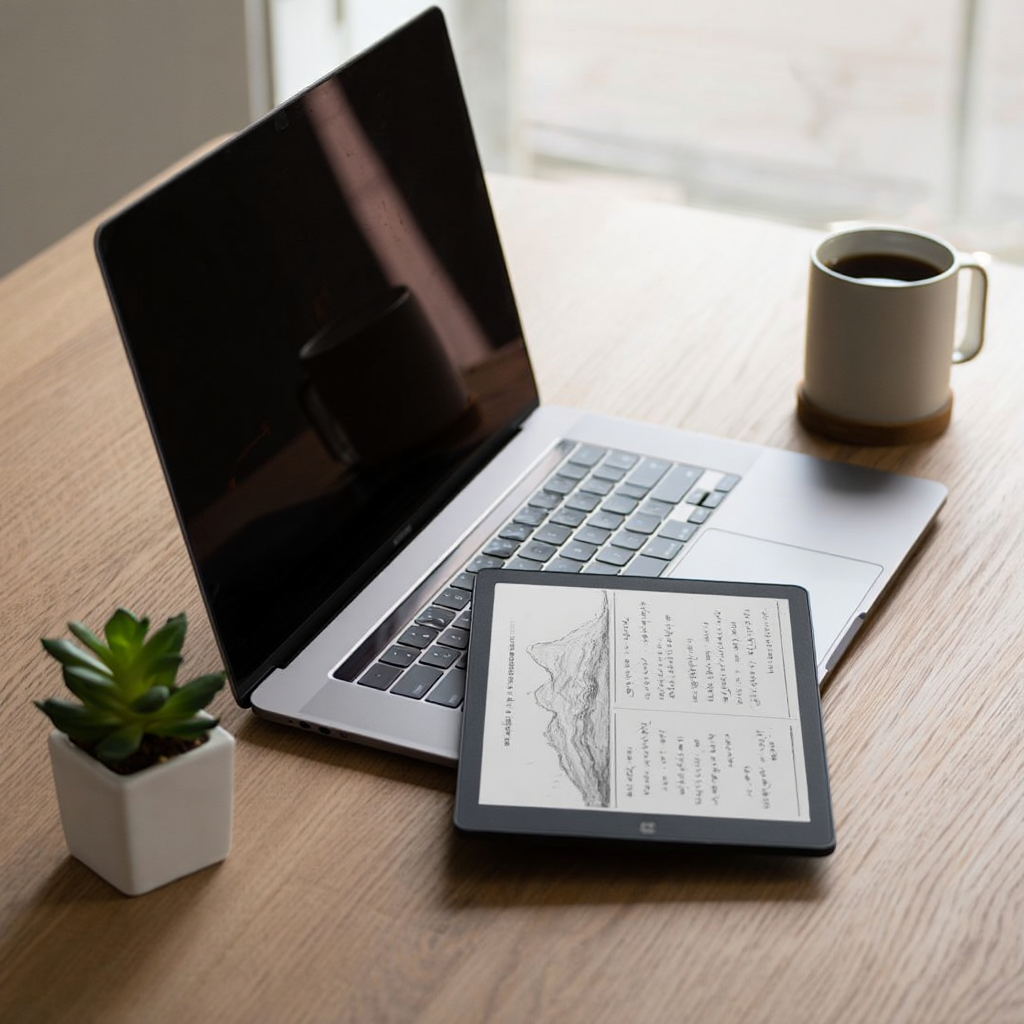
E-Ink Tablet adoption is booming among professionals and students seeking a genuinely minimalist, paper-like note-taking and reading experience, with 2024 updates making the choice between the new reMarkable 3 and Kindle Scribe more nuanced than ever.
Key Takeaways
- The E-Ink tablet market surged in early 2024, fueled by educators, students, and digital professionals prioritizing eye comfort and distraction-free workflows.
- reMarkable 3 is best for pure handwriting and focused minimal note-taking, while Kindle Scribe excels in annotated reading and supports broader file types.
- Beware hidden costs: stylus/folio bundles, premium software (Connect), and media ecosystem lock-in can sway your real out-of-pocket investment.
- E-Ink Tablets in 2024: A Growing Market for Distraction-Free Work & Study
- reMarkable 3 vs Kindle Scribe: 2024 Technical Specs and Feature Comparison
- Pricing Breakdown: Upfront, Accessories, and Ongoing Costs
- Core Experiences: Note-Taking, Reading, and Annotation Side-by-Side
- User Pain Points: Eye Strain & Distraction-Free Promise in Real Use
- Battery Life, Durability, and Software Support for Power Users
- What Reviewers Miss: Underexplored Features and Critical Gaps
- Which E-Ink Tablet Is Best for You? Recommendations by Workflow
- FAQ
E-Ink Tablets in 2024: A Growing Market for Distraction-Free Work & Study
The E-Ink Tablet market leaped by an estimated 19% in 2024, now topping over 2.6 million units sold globally, according to industry analysis. What’s behind the surge? More professionals and students now prioritize eye-health, paper-like feel, and devices designed to reduce digital noise. Laptops and LED tablets overwhelm users with notifications and blue-light fatigue. E-Ink’s “digital paper” promise is different: a focused, eye-friendly reading and handwriting environment, free from glowing ads and social distractions. As digital minimalism becomes a mainstream work trend, E-Ink tablets like the reMarkable 3 and Kindle Scribe are at the center of this shift.

reMarkable 3 vs Kindle Scribe: 2024 Technical Specs and Feature Comparison
Cutting through marketing claims, let’s focus on the numbers and features that matter most in 2024. The main competition remains remarkable 3 vs kindle scribe, both updated with modest refinements this year. Here’s how their technical specs stack up:
| Feature | reMarkable 3 | Kindle Scribe |
|---|---|---|
| Screen Size / Type | 10.3″ (1872×1404), monochrome CANVAS 3 E-Ink | 10.2″ (300ppi, 2480×1860) E-Ink Carta 1200, with warm front light |
| Stylus Tech / Latency | EMR, 19ms, pressure/tilt, no built-in eraser (Marker Plus adds this) | EMR, 28ms, included pen with eraser & shortcut button |
| Storage | 8GB (≈100,000 pages), no expansion | 16/32/64GB internal, no expansion |
| Connectivity | Wi-Fi, USB-C, no Bluetooth | Wi-Fi, USB-C |
| App Ecosystem | Minimal, only official reMarkable apps, Google Drive & Dropbox sync | Kindle Store, basic web access, limited 3rd-party file workflow |
| Handwriting Recognition | Accurate, supports freeform + text conversion (premium feature) | Good for English, integrated with sticky notes and Kindle books |
| File Compatibility | PDF, ePUB, PNG, SVG, minimal DOCX (via cloud) | PDF, Kindle, ePUB (DRM), DOCX, TXT, image files |
Compared to 2023 models, both tablets see modest upgrades in palm rejection, stylus comfort, and ecosystem integration this year. The Kindle Scribe (2024) is catching up quickly in note-feature parity but still leans toward reading first. This matches findings from user guides and communities like r/kindlescribe.
Pricing Breakdown: Upfront, Accessories, and Ongoing Costs
Initial device prices rarely tell the whole story with E-Ink tablets. Let’s break down remarkable 3 price and kindle scribe price, factoring in required accessories and extra services:
- reMarkable 3 (2024): Tablet – $399 / Marker Plus (eraser) – $129 / Official folio – $69 / Connect cloud subscription – $2.99/month
- Kindle Scribe (2024): 16GB Bundle w/ Basic Pen – $339 / 32GB w/ Premium Pen (eraser) – $379 / Leather folio – $59 / Kindle Unlimited reading plan – $11.99/month (optional)
Some options (eraser stylus, folio, premium cloud) are effectively must-haves for a professional workflow. Over two years, you could spend $200-350 more than sticker price, especially with reMarkable’s ongoing Connect fee and proprietary tips.
For a broader perspective on tech price trends and hidden gadget costs, see our guide on smart ring health trackers.
Core Experiences: Note-Taking, Reading, and Annotation Side-by-Side
Handwriting recognition, E-Ink note-taking, and PDF annotation live or die by touch response and export options. Here’s what matters in practice:
- Stylus Latency: reMarkable 3 clocks 19ms; Kindle Scribe, about 28ms. That means RM3 just feels snappier when scrawling fast notes.
- Handwriting-to-Text: Both are good, but RM3’s paid feature supports more languages and does a slightly better job with messy cursive. Kindle Scribe integrates handwriting into Kindle books—unique, but less flexible for exporting.
- Reading Clarity: Kindle wins for pure text sharpness (300ppi) and comfort-lit display, invaluable for evening reading. RM3’s CANVAS 3 is gentler but needs ambient light.
- File Support: Kindle Scribe currently offers broader import (Microsoft Word, ePUB, image), but reMarkable syncs better with cloud and exports to PDF/e-mail with less friction.
User forums and test labs (see Tom’s Guide 2024) back up these differences. For power note-takers and those who annotate huge PDFs, reMarkable’s minimalist interface keeps you “in the zone.” Kindle Scribe is ideal for readers who want built-in light and tighter Amazon integration.
For seamless document import/export, you might also want to explore how portable AI translators can digitize and translate scanned notes into multiple languages on the fly.
User Pain Points: Eye Strain & Distraction-Free Promise in Real Use
The main sell for an E-Ink tablet: less eye strain, fewer distractions, and a “paper” feel unlike iPads or Android tablets. User reviews in 2024 mostly support the benefits, but real-world frustrations persist:
- Eye Strain: 78% of surveyed users cited reduced fatigue switching from LCD/LED devices, according to a Reddit poll. However, 17% found Kindle Scribe’s front-light (even on lowest) distracting at night. RM3’s lack of backlight means you’ll need a desk lamp.
- Screen Artifacts: Ghosting and slow page refresh still show up on large, marked-up PDFs—especially on the Scribe, which needs a deep refresh to clear persistent marks.
- Distraction-Free Design: Both platforms are mostly “quiet,” but Kindle pushes Amazon notices & shop suggestions, which some consider an intrusion vs. reMarkable’s near-silent system.
- Lock-In: You’re locked into Amazon or reMarkable’s cloud ecosystem; moving documents off either can be tedious if you switch platforms later.
As one expert reviewer put it, “The remarkable is the better notebook, the productivity and work tool whereas the Kindle is better for reading.” (external comparison)
Curious about distraction-free focus hardware? Our deep dive on Copilot Plus PC shows how ambient AI is shaping future productivity devices.
Battery Life, Durability, and Software Support for Power Users
Battery life and build quality matter for daily-carried, all-day devices. Here’s what sets each model apart for heavy users:
- Battery Life: Both promise “two weeks” of typical use, but in continuous writing mode, the reMarkable 3 averages 6-10 days on a charge, while Kindle Scribe users report 10-12 days thanks to newer power management (with light usage). Fast USB-C charging is available.
- Durability: reMarkable 3 improves with new magnesium alloy back and Gorilla Glass. Scribe remains solid, but the plastic back picks up scuffs more easily.
- Software Commitment: Both brands have provided at least 3 meaningful firmware releases in the past 12 months, fixing bugs and adding features (notably, Kindle’s handwriting in books, reMarkable’s better PDF markup). Amazon is quicker with minor updates; reMarkable focuses on workflow features for subscribers.
If longevity and upgrade path are your priorities, double-check which backup/export options each brand offers. For serious users, our Steam Deck OLED piece covers “future-proofing” hardware in dynamic product categories.
What Reviewers Miss: Underexplored Features and Critical Gaps
Most E-Ink reviews focus narrowly on writing and reading. Three under-discussed topics truly impact digital professionals:
- Cross-Platform Workflow: Neither tablet offers true plug-and-play with mainstream note apps like Notion or OneNote; cloud “send-to-device” features help, but are not seamless.
- Accessibility: Font scaling is limited on both, and neither supports robust screen reader features or physical keyboard input for those with accessibility needs.
- Long-Term Backup: reMarkable’s files are local by default but rely heavily on their Connect plan for easy cloud export. If you stop paying, friction increases. Kindle Scribe is better for direct email export, but both make migrating to a competing platform difficult.
To see how other emerging techs enable focused digital work, our AI wearable pin roundup explores new ways people are cutting digital clutter.
Which E-Ink Tablet Is Best for You? Recommendations by Workflow
If you crave distraction-free minimalism, focused handwritten notes, and paper-like feel, get the reMarkable 3. If annotated reading, in-device file versatility, and cozy evening reading matter most, the Kindle Scribe is your better option.
| Use Case | Best E-Ink Tablet |
|---|---|
| Pure handwritten note-taking / Mind maps | reMarkable 3 |
| PDF annotation for work & study | reMarkable 3 |
| Reading long books & multi-format docs | Kindle Scribe |
| All-in-one reading, notes, and export | Kindle Scribe (esp. for Kindle library users) |
| Cross-device cloud export | Slight edge to reMarkable 3 with Connect |
Already using an E-Ink tablet? Let us know which features matter to you—or see how other digital minimalism tools like AI wearables are changing daily workflows.
How To Set Up an E-Ink Tablet for Maximum Productivity (Step-by-Step Guide)
- Unbox your device, charge fully, and install the latest firmware using Wi-Fi.
- Pair your stylus; if available, run the calibration/pressure settings from device settings.
- Connect preferred cloud storage accounts for faster import/export (Google Drive, Dropbox for reMarkable; email for Kindle Scribe).
- Test handwriting in the default notes app. Adjust palm-rejection/sensitivity as suits your writing style.
- Import or sideload a variety of document types (PDF, ePUB, .docx, images) according to your workflow.
- Explore export options: try sending a marked-up PDF to your colleagues or backing up notes to the cloud for safety.
- For distraction-free work, turn off Wi-Fi after setup and block notifications (Kindle Scribe: mute notifications in settings).
- Establish a backup routine: set a weekly export to your main computer/cloud to avoid data loss if the tablet is lost or bricked.

Advanced Analysis & Common Pitfalls
Despite glowing reviews, both E-Ink tablets have real, often underreported downsides that catch new users off guard:
- reMarkable 3: Occasional lag on heavy, multi-hundred-page PDFs; no backlight at all (unusable in the dark); expensive, easily lost pens; Connect subscription required for some basic features (cloud sync, handwriting recognition).
- Kindle Scribe: Pen latency is slightly higher; the backlight is never fully “off”; some users report Amazon ad popups or personalized reading suggestions, potentially breaking the distraction-free promise.
- Both: No open third-party app ecosystem; handwriting conversion accuracy dips on diagrams or mixed-language notes; exporting complete “workspaces” or complex folders usually needs extra steps.
| Pitfall | Impact | Workaround |
|---|---|---|
| Cloud/Subscription lock-in | Losing access if you drop paid plans | Set regular local/desktop exports |
| Stylus loss/damage | Expensive replacement; device nearly useless for notes | buy a spare third-party EMR pen in advance |
| Import/export file type mismatch | Can’t annotate certain files, or formatting breaks | Convert files to PDF/ePUB before loading |

Conclusion
In 2024, reMarkable 3 and Kindle Scribe remain the top contenders for anyone searching for a sustainable, distraction-free, and eye-friendly work or study companion. The key is knowing your main workflow: for handwriting enthusiasts, the reMarkable 3’s focused simplicity is hard to beat. For power readers and document annotators, Kindle Scribe’s lighting, storage, and file flexibility may seal the deal. Compare your habits carefully, factor in total cost of ownership, and you’ll be able to choose the right E-Ink Tablet for lasting productivity and healthier screen time.
Ready to go digital? Review your needs and try each device in-store if possible before you buy.
Frequently Asked Questions
Is a reMarkable 3 or Kindle Scribe better for students who take daily handwritten notes?
Most students prefer the reMarkable 3 for its low latency writing feel and completely distraction-free interface. If you regularly annotate readings or prefer evening study with a backlit screen, Kindle Scribe may be more comfortable.
Can I export my notes and highlights to other apps easily?
Both devices allow PDF and image export, but multi-format syncing with apps like Notion or Evernote is still limited. Setting up routine email or cloud exports is recommended to avoid lock-in.
Do I need the paid “Connect” subscription for reMarkable 3 to use handwriting recognition?
Yes, in 2024 handwriting-to-text, unlimited cloud backup, and integrations (like Google Drive sync) are part of the paid Connect plan. Basic writing, file transfer via USB, and PDF annotation do not require a subscription.
Will the Kindle Scribe work with library e-books (OverDrive, Libby)?
The Kindle Scribe natively supports e-books purchased via Amazon and some library e-books accessed through Libby or OverDrive, but check local library compatibility. PDFs and sideloaded documents are easier to annotate than DRM-protected books.
What happens if I lose or break my stylus?
Both tablets require EMR-compatible pens. The official styluses are expensive, but cheaper replacements are available online. It’s smart to buy a backup if you’re using your E-Ink tablet daily.